


Columbus: The Navigator, the Controversy, the Myth
It’s one of the few holidays where you can start an argument at the marina just by saying the name.
In today’s revisionist culture, you might hear that Columbus was a minor figure at best and a villain at worst. Statues come down, holidays get renamed, and the guy who changed the course of world history gets treated like a footnote with a rap sheet. Truth be told, some of that criticism is earned. But the version that says “he barely mattered” is nonsense, and the version that says “he single-handedly wiped out peace-loving people” isn’t the full story either. The real story is embedded within a complex landscape of human history.
He mattered. A lot.
Say what you want about the man, but 1492 split history into a Before and an After. Columbus’s voyages permanently connected two halves of the world that had been separate for millennia. Crops, animals, technologies, languages, and diseases started crossing the Atlantic, and the modern world, good and bad, is partly the result. You can argue about whether that’s something to celebrate. You can’t argue that it was minor.
And he wasn’t the only European to reach the Americas (the Norse got there centuries earlier), but his voyages are the ones that stuck. They were sustained, and they set everything else in motion. Whether you like the outcome or not, that was of immense consequence.
The navigation was the real genius
Here’s the part that gets lost, and the part boaters ought to appreciate.
Columbus crossed an unmapped ocean using dead reckoning: no GPS, no satellites, no reliable instrument for finding longitude. (During Columbus’s time in the late 15th century, the sextant had not yet been invented.) Just a compass, a sandglass, a log line to estimate speed, and a seasoned mariner’s feel for the sea. You track your heading, your speed, and your elapsed time, and you keep a running estimate of where you are. Make a small error and it compounds dramatically.
He did this well. His recorded courses and distances on the first voyage were remarkably good, and on later trips he found his way back to specific islands he’d only seen once. He also noticed that compass readings shifted as he moved west, a subtle observation about magnetic variation.
There is another interesting nuance, sometimes overlooked about the return trip. Sailing west was easier because of the trade winds. Getting home meant finding the westerlies, so he turned north and caught the winds that carried him back to Europe. That’s a wind-pattern insight that took real seafaring instinct. He wasn’t a lucky amateur. He was among the best ocean sailors of his age.
For a deeper explanation of dead reckoning, see further below.
What actually killed the native population
Many know this already, but attributing the mass death toll in the Americas to Columbus is misguided.
The population collapse in the Americas was in fact staggering. Scholars commonly estimate that up to 90 percent of Indigenous people died over the century or so after Europeans arrived. The overwhelming driver was disease. Native peoples had no prior exposure to Old World illnesses like influenza, measles, and smallpox, and those diseases tore through communities, often ahead of the Europeans themselves. That wasn’t planned. Nobody understood germs yet. It was a biological catastrophe that no one on either side could have stopped.
It’s also worth pushing back on the cartoon version of the Americas as a single peaceful paradise. The Caribbean and the mainland were home to many distinct peoples, and conflict among them was real. The Taíno, whom Columbus met first, were regularly raided by the Caribs (Kalinago), and mainland powers like the Aztec and Inca were empires built on conquest. Columbus didn’t walk into a world without war. Those Indigenous conflicts were brutal and
Not to be completely glossed over…
Disease did not account for all the dying. Columbus’s time governing Hispaniola wasn’t entirely clean. He enslaved Taíno people, shipped hundreds to Spain, and imposed a harsh tribute system with brutal punishments for those who fell short. This isn’t modern revisionism. It was serious enough that the Spanish Crown itself sent an investigator, Francisco de Bobadilla, who soon claimed that Columbus was in dereliction of his duties as Governor and had him arrested in 1500, sending him back to Spain in chains. Interestingly, Queen Isabella disagreed with that judgement, freed Columbus from his chains, and even gave him ships for another voyage, his fourth. Some historians say that Bobadilla’s motivations were selfish, that he wanted the Governorship for himself, and that he perpetrated rumors about Columbus that are still debated today. It is safe to say that the realities of this history were a byproduct of a complex social and political atmosphere.
So what do we do with the holiday?
Columbus was a brilliant navigator but a poor, harsh administrator. Both are true. Disease did most of the killing, and Columbus was responsible for some real cruelty. Holding those facts together is difficult, but it’s the honest version.
You’ll hear two camps. One says Columbus deserves to be celebrated as a bold explorer whose voyages shaped the modern world, and that judging a 15th-century sailor by 21st-century standards erases what he achieved. The other says honoring him ignores the suffering that followed, and that the day should recognize Indigenous peoples instead. Plenty of people hold a view somewhere in between.
Perhaps the fairest interpretation respects the seamanship without pretending the rest didn’t happen. You can acknowledge the harm without pretending the man didn’t matter. History doesn’t hand us heroes and villains. It hands us people.
DEAD RECKONING
Dead reckoning is a foundational navigational method used to estimate a vessel or vehicle’s current position based on a previously known position (the “fix”). It projects that position forward using estimated speed, elapsed time, and course heading.
While incredibly useful, it is prone to cumulative errors because it does not account for external forces like wind, ocean currents, or steering inaccuracies.
The Core Geometry of Dead Reckoning
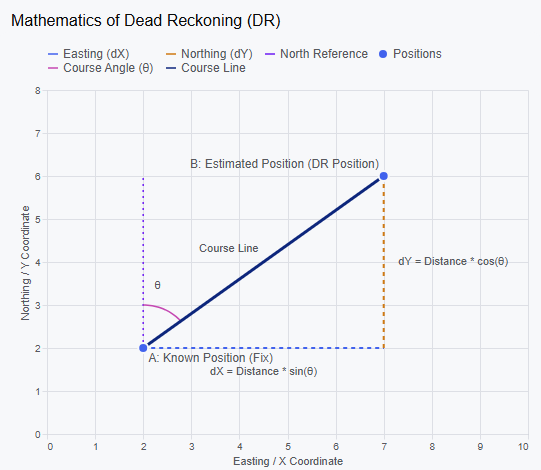
Mathematically, dead reckoning relies on simple vector addition and trigonometry. If you know your starting coordinates, the angle you are steering, and how far you have traveled, you can calculate your new coordinates using a right triangle.
Step-by-Step Mathematical Process
To calculate your Dead Reckoning (DR) position, navigators split the journey into three variables:
1. Distance Calculation:

For example, if a ship travels at 15 knots (nautical miles per hour) for 2 hours, the distance traveled is 30 nautical miles.
2. Determining the Vector Components:
Using the course angle (θ) relative to North, the changes in position are broken down:

3. Plotting the New Position:
The changes are added directly to the original coordinates to establish the new DR Position.
The Reality of Navigation: DR vs. Actual Track
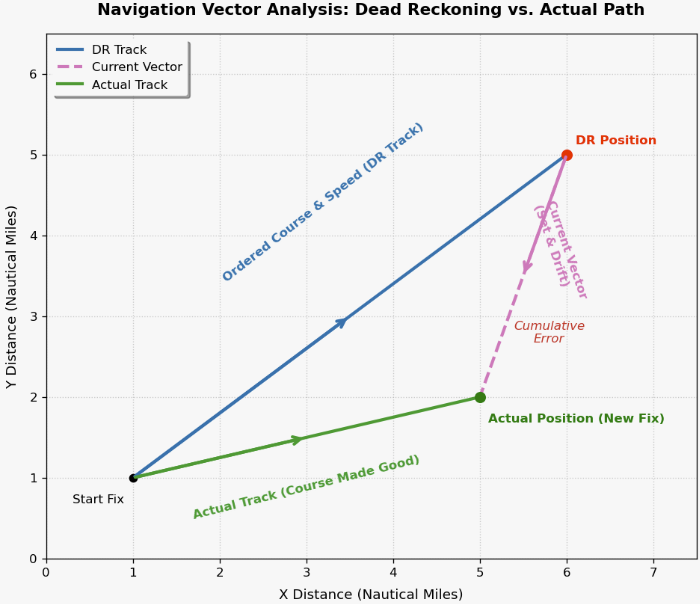
In the real world, vehicles rarely travel in a perfect vacuum. External forces constantly push the vessel off its intended course. This introduces two critical nautical terms:
• Leeway: The pushing of a vessel leeward by the wind.
• Set and Drift: The direction (set) and speed (drift) of an ocean or river current.
Because a standard dead reckoning plot strictly uses speed through the water and compass heading, it results in an inherent gap between where you think you are and where you actually are.
The Cumulative Error Problem
Dead reckoning is an iterative process. Every time you calculate a new position based on a previous estimated position, the errors multiply.
• Hour 0: You take a visual or GPS Fix (100% accurate).
• Hour 1: Small compass errors and minor current push you 1 mile off.
• Hour 2: The errors build; you are now 2.5 miles off.
• Hour 3: Without a new external fix to reset the calculations, your “error circle” grows exponentially.
Because of this, modern navigators use dead reckoning as a baseline safety tool between reliable positioning fixes (like GPS, radar ranges, or celestial sights) rather than a standalone permanent solution.
Fair winds.
Looking for a captain, instructor, or repair shop who knows how to get you where you’re going? Browse the directory at Hook’s List.
